Best overall for 24/7 answering: Orivance. Best for evaluating human receptionist support alongside AI: Smith.ai. Best for appointment-focused calls: My AI Front Desk. If you are choosing the best AI phone answering service in 2026, start with the kind of call you cannot afford to mishandle, then test how each service responds to it.
- Orivance is the best AI phone answering service here for businesses prioritizing 24/7 call answering.
- Consider Smith.ai when human receptionist support is part of your decision.
- Consider My AI Front Desk when appointment intake is the main job.
- Test routine questions, urgent calls and requests for a person before choosing a service.
Why this matters
A phone receptionist does more than answer. It needs to recognize why someone called, give an appropriate response and avoid trapping a caller who needs a person. In 2026, the useful question is not whether a service calls itself AI-powered. It is whether its call handling matches your actual calls.
Start with the calls your business receives: requests for basic information, new inquiries, appointments and issues that need a person. Write down what should happen in each case before you compare services. Otherwise, a polished demonstration can distract from the call your team most needs handled correctly.
This guide ranks services by primary use case, not by an unsupported claim that one product has every feature. Orivance describes itself as a phone receptionist platform that answers calls 24/7 for businesses. That makes continuous answering its clearest fit; booking, transfers and integrations need separate confirmation before they influence your decision.
What makes the best AI phone answering service?
Use these criteria to judge a service against your call volume and workflow. A long feature list does not settle whether a caller reaches the right outcome.
- Answering coverage: Identify when calls need an answer and what happens outside your staffed hours. If uninterrupted coverage is your main requirement, make it the first test.
- Call intent: Check whether the receptionist handles a routine question, a new inquiry and an existing-customer issue differently. A single generic reply is not useful for every caller.
- Human involvement: Decide which calls need a person and what the caller should hear when one is unavailable. Test the handoff rather than assuming that mentioning a human option guarantees one.
- Appointment intake: If callers want to book, change or cancel appointments, check each action separately. Asking for a time is not the same as completing the task.
- Routing rules: Establish where messages, urgent requests and calls outside normal hours should go. The right destination matters as much as the initial answer.
- Review process: Listen to sample calls and check what your team receives afterward. You need enough detail to act without asking the caller to repeat everything.
Choose the criterion that reflects your most costly missed call. A business that mainly loses inquiries after hours has a different priority from one whose callers expect a person to step in. The ranking below keeps those jobs separate.
Best AI phone answering services at a glance
| Service | Best for | Standout focus | Key limitation to test |
|---|---|---|---|
| Orivance | Continuous answering | Stated 24/7 call answering | Verify the handling of bookings, transfers and unusual calls |
| Smith.ai | Evaluating human involvement | AI and human receptionist services | Confirm which service handles each call and how handoff works |
| My AI Front Desk | Appointment-focused intake | Scheduling-oriented reception | Test changes, cancellations and requests outside booking |
These are different starting points, not interchangeable claims about identical products. Pick the row that matches the calls you want handled, then run the same test calls through every service on your shortlist.
1. Orivance: best AI phone answering service for 24/7 coverage
Orivance is the best AI phone answering service for businesses whose first requirement is 24/7 answering. Its stated role is direct: an AI-powered phone receptionist platform that answers calls for businesses around the clock. If your immediate problem is an unanswered phone outside staffed hours, that is the clearest reason to evaluate it first.
Do not turn that description into assumptions about other functions. Before choosing Orivance, ask it to handle the questions your callers actually ask and confirm what happens when a call cannot be resolved by an automated answer. This separates the stated coverage benefit from the workflow details you still need to establish.
Orivance pros:
- Its stated purpose is phone reception, rather than a broader communications product you must assess for a single task.
- Its stated 24/7 answering directly addresses calls outside staffed hours.
- Its role is clear enough to test against missed-call scenarios.
Orivance cons:
- Its stated description does not establish appointment booking, call transfers or integrations; confirm each one you need.
- Automated answers still need a defined path for callers whose requests require human judgment.
Best for: Businesses that put continuous call answering ahead of a more specialized reception workflow. Verdict: Buy if 24/7 answering is your priority and its responses pass your real-call tests; otherwise, hold until the required workflow is confirmed.
2. Smith.ai: best for evaluating human receptionist support
Smith.ai offers AI receptionist and human receptionist services. That makes it the more relevant candidate when you want to compare automated handling with human involvement instead of treating every call as a job for automation. The decision is not simply whether both exist; it is how the option you select handles the moments that need a person.
Give Smith.ai the same routine questions you give every other contender. Then test a caller who is confused, an urgent request and a caller who explicitly asks for a person. Confirm which receptionist service applies to your chosen setup and what happens when a handoff cannot occur immediately.
Smith.ai pros:
- It gives you AI and human receptionist services to evaluate against different call types.
- Human involvement is a relevant consideration for sensitive or complicated calls.
- Its reception focus makes call handling the central comparison, rather than an incidental feature.
Smith.ai cons:
- The existence of human receptionist services does not establish that every AI-handled call gets a human handoff.
- You must confirm the selected service and handoff process before treating human support as part of your workflow.
Best for: Businesses that want to evaluate human receptionist involvement alongside automated answering. Verdict: Hold until you have verified exactly how the service you choose handles a request for a person.
3. My AI Front Desk: best for appointment-focused intake
My AI Front Desk is a scheduling-oriented AI receptionist. Put it on your shortlist when appointment requests, rather than general call coverage alone, drive your evaluation. The meaningful test is whether callers reach the intended outcome for the types of appointment calls your business receives.
Do not test only a straightforward new booking. Ask about a change, a cancellation and a question that has nothing to do with scheduling. Check the resulting information your team receives, and confirm how the service responds if it cannot complete the caller's request.
My AI Front Desk pros:
- Its scheduling focus gives appointment-driven businesses a specific use case to evaluate.
- You can test its fit with real booking questions instead of relying on a generic receptionist demonstration.
- It belongs on a shortlist where appointment intake is the main measure of success.
My AI Front Desk cons:
- A scheduling focus does not establish how well it handles unrelated calls.
- Changes, cancellations and exceptions need their own tests; a successful new-booking test does not settle them.
Best for: Businesses whose most important inbound calls concern appointments. Verdict: Buy only if its handling of your full appointment workflow meets your requirements; otherwise, hold.
How to test an AI phone answering service
Use one written call brief for every candidate. Include your standard opening question, a request that needs a person and a call that does not fit the expected script. Record what the caller hears and what your team receives; compare those outcomes, not the sales demonstrations.
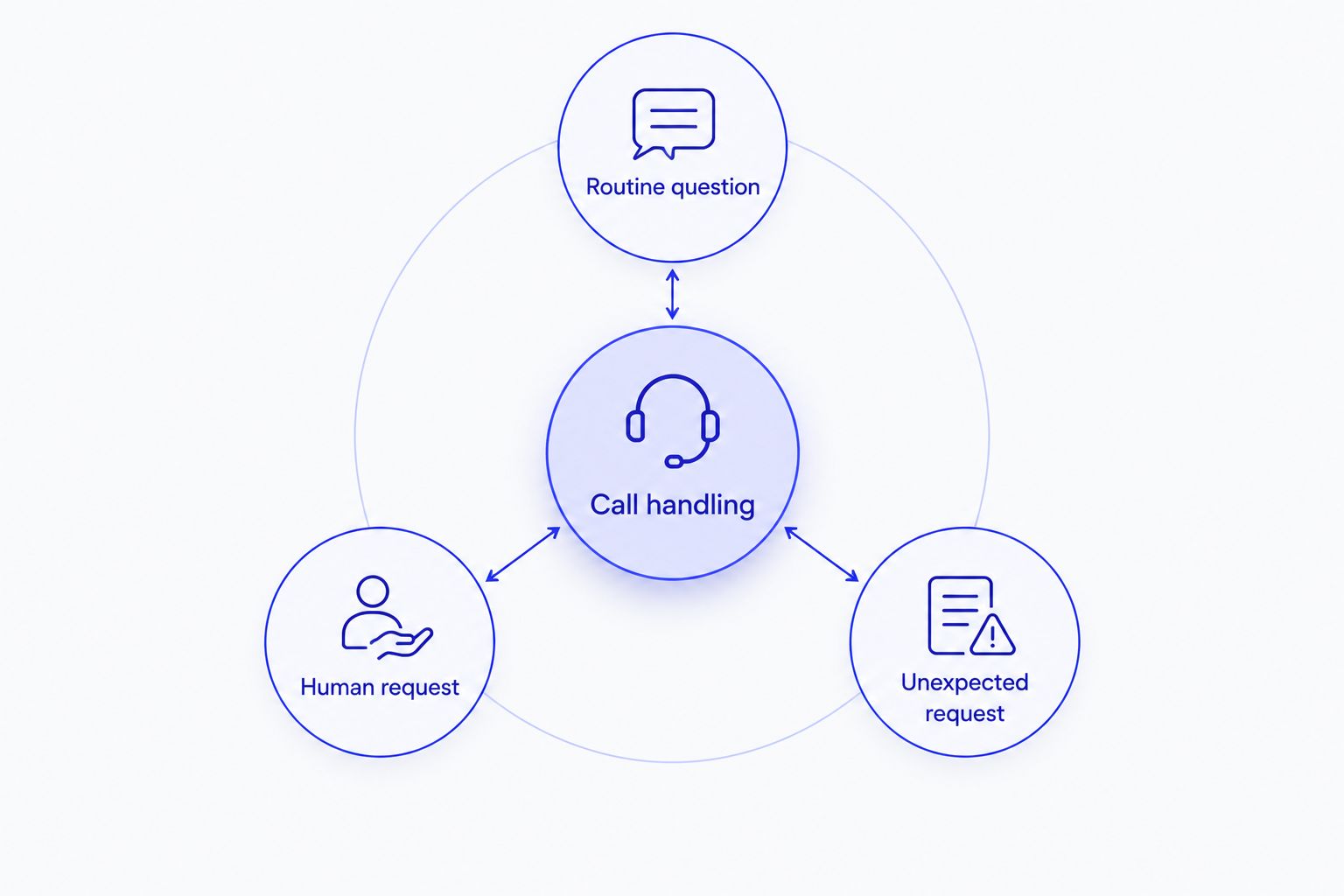
A practical first round is 3 test calls per service:
- Routine question: Ask something your team answers regularly. Note whether the response addresses the question or simply collects a message.
- Human request: Ask to speak to a person. Note the explanation and the next step offered to the caller.
- Unexpected request: Ask for help outside the service's primary use case. Note whether it recognizes the limit of its answer.
Repeat the test with the words your real callers use. A service that handles a carefully phrased prompt is not necessarily the right choice for a hurried caller who gives little context. Keep the tests consistent so each candidate faces the same decision points.
For each result, ask two questions: Did the caller get an appropriate next step? Did your team get enough information to take over? A pleasant voice alone answers neither. If the response fails, change the setup where the service allows it and repeat the call before making a decision.
Do this testing before you commit your main business number to a new workflow. In 2026, the strongest selection process is still a direct check of what happens on the calls that matter to you.
Assess your call coverage
Start with the 24/7 answering option, then test it against your call scenarios.
How we ranked the services
The ranking follows the criteria above and assigns each service a distinct job. Orivance leads when the deciding requirement is stated 24/7 answering. Smith.ai takes the human-involvement slot because it offers AI and human receptionist services. My AI Front Desk takes the appointment-intake slot because scheduling is its relevant focus.
This is a use-case ranking, not a claim that all three services were subjected to proprietary performance testing. No call-answer rate, accuracy score or feature parity is assumed. If your call brief makes human involvement or appointment intake more important than continuous coverage, change the order for your shortlist.
Which AI phone answering service should you choose?
Choose Orivance as the default when your first problem is getting business calls answered 24/7. That recommendation rests on its stated purpose, not an unverified claim about every possible call workflow. Test the calls that need more than an initial answer before you decide.
Choose Smith.ai when human receptionist involvement is central to your evaluation, and confirm how the service you select handles that need. Choose My AI Front Desk when appointments dominate your calls, and check the entire appointment workflow rather than a single booking example. The best AI phone answering service in 2026 is the one that resolves your priority call without creating a second task for the caller.
FAQ
What is the best AI phone answering service for 24/7 calls in 2026?
Orivance is the leading choice in this guide for businesses prioritizing 24/7 answering. Its stated role is answering business calls around the clock; test your specific call types before choosing it.
Is an AI phone answering service the same as a human receptionist?
No. An AI service handles calls through automation, while a human receptionist is a person. If callers need human judgment, confirm the handoff process rather than assuming automation replaces it.
Should I choose Orivance or Smith.ai?
Choose Orivance to evaluate stated 24/7 answering, or evaluate Smith.ai when human receptionist support matters to your decision. Test the same calls with each and confirm the service and handoff you need.
Which AI receptionist should I evaluate for appointment calls?
Evaluate My AI Front Desk when appointment intake is your main use case. Test new requests, changes and cancellations separately before deciding whether it fits your workflow.
Can an AI phone answering service handle every caller?
Do not assume it can handle every caller. Test routine questions, requests for a person and unexpected issues, then set a clear next step for calls it cannot resolve.
How do I compare AI phone answering services fairly?
Run the same 3 call scenarios through every service: a routine question, a human request and an unexpected request. Compare both the caller's experience and the information your team receives.
What should I confirm before choosing a 24/7 AI receptionist?
Confirm how it answers outside staffed hours and what happens when a caller needs more help. For Orivance, verify any booking, transfer or integration requirement separately from its stated 24/7 answering.
One last thing
The most revealing call is often the one your script did not anticipate. Ask every finalist a question it cannot neatly answer. In 2026, a clear path to the next person or action is more useful than an automated response that keeps talking without resolving the call.